Ticket: Regular
Ticket: Theory-module
Jane C. Messina
Honorary Course Directors
Riccardo Luchetti
Pietro Simone Randelli
Scientific Committee
Paolo Arrigoni
Andrea Atzei
R. Arora – Innsbruck, Austria
P. Arrigoni – Milan, Italy
A. Atzei – Treviso, Italy
E. Carità – Verona, Italy
V. Carratalà – Valencia, Spain
A. Celli – Modena, Italy
A. Colozza – Faenza, Italy
F. Corella – Madrid, Spain
P. Delgado – Madrid, Spain
G. Herzberg – Lyon, France
G. Lauri – Florence, Italy
A. Lazzerini – Milan, Italy
R. Luchetti – Rimini, Italy
L. L. Marcovici – Rome, Italy
L. Marzella – Milan, Italy
L. Merlini – Paris, France
J. C. Messina – Milan, Italy
S. Pfanner – Florence, Italy
P. S. Randelli – Milan, Italy
E. Viola – Cremona, Italy
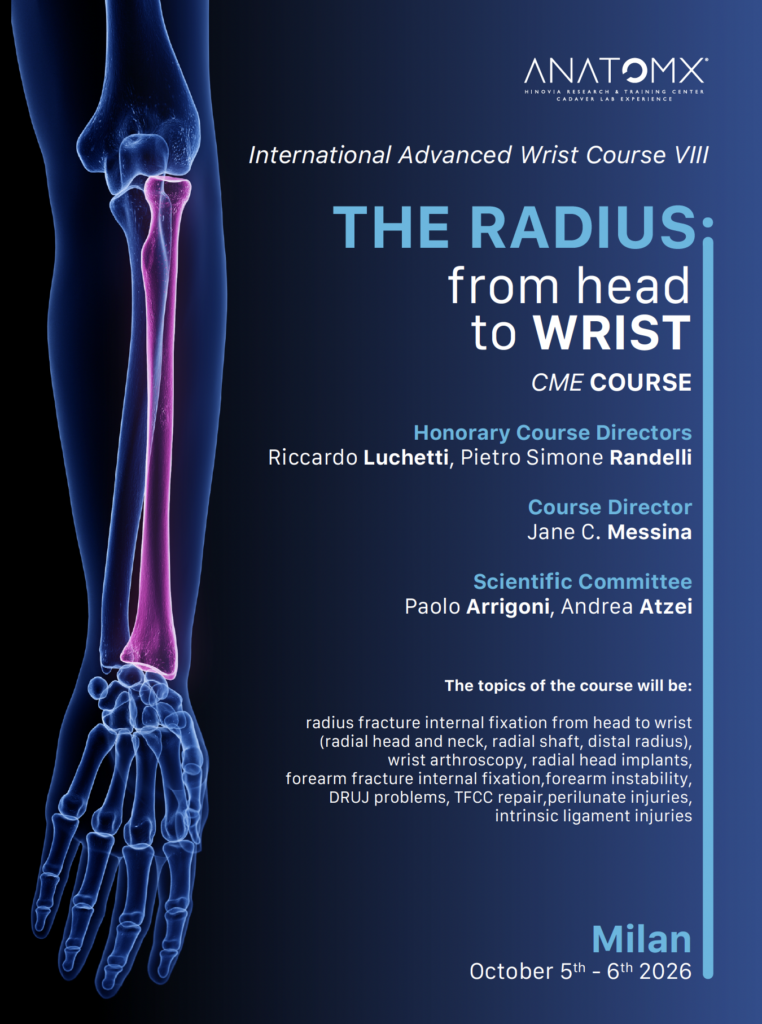
This course has been designed to give participants the opportunity to master a variety of techniques for treating traumatic and post-traumatic conditions of the forearm and wrist.
The radius is a pivotal bone – it grants stability to the wrist, but its ability to rotate at both the proximal and distal radio-ulnar joints enables forearm pronosupination. Because this segment is so mobile, a surgeon must know how to restore optimal function after injury.
During the course, we will learn internal fixation techniques for the proximal and distal radius, as well as the radial shaft. Participants will also learn about radial head implants and ligament reconstruction. We will explore a broad spectrum of radio-carpal trauma, including distal radius articular fractures, radiocarpal dislocations, perilunate injuries, scaphoid fractures and nonunions, and intracarpal ligament injuries.
In addition to theoretical sessions, this is a hands-on cadaver lab course: participants will be able to learn a variety of surgical techniques – both open and arthroscopic – and will have the opportunity to reproduce them on cadaver specimens, ensuring a deeply practical learning experience.
The event is accredited (21,9 CME credits) for Physiotherapists and Orthopedists and Plastic Surgeons
Proximal radius and Forearm – Moderators: P. Arrigoni, E. Viola
7.45
Registration of participants
8.00
Presentation of the Course – P. S. Randelli, R. Luchetti, J. C. Messina
8.20
Mechanism of trauma and surgical management of radial head fractures and terrible triad – P. Arrigoni
8.30
Degrees of severity of terrible triad injuries – G. Herzberg
8.40
Classification and internal fixation of radial head fractures – E. Carità
8.50
Arthroscopic management of radial head fracture and involvement of PRUJ – A. Colozza
9.00
Radial head implants: indications and long term results – A. Celli
9.10
Surgical management of complex forearm and radial head fractures – R. Arora
9.20
Proximal radial shaft fractures and relationships with radial nerve – G. Lauri
9.30
Longitudinal instability of forearm – A. Colozza
9.40
Radio-ulnar synostosis – S. Pfanner
9.50
How to manage post-traumatic limitation of pronosupination – J. C. Messina
10.00
Discussion
10.20
Coffee break
10.40
Cadaver Lab
• Radial head fracture and internal fixation with screws/plates
• Radial head implants
• Internal fixation of forearm fractures
• Isolation of radial nerve and other nerves in the forearm
13.00
Lunch
Distal radius and DRUJ – Moderators: A. Atzei, A. Lazzerini, S. Pfanner
14.00
Open management of distal radius fractures, extra and intra-articular by volar approach – L. Marzella, A. Lazzerini
14.10
Intra-articular fractures when to choose volar, dorsal or combined approach: technical details – G. Lauri
14.20
Arthroscopic management of two part DRF fractures – with ligament lesions – J. C. Messina
14.30
Arthroscopic management of complex articular fractures of distal radius: technique – G. Herzberg
14.40
Management of Instability of DRUJ and acute TFCC injuries: what to do? – V. Carratalà
14.50
The “boutonniere-like” effect of the fixed ulnar head during forearm rotation. Clinical relevance – G. Herzberg
15.00
Management of Instability of DRUJ: chronic injuries, what to do? – A. Atzei
15.10
Radiocarpal stiffness: open or arthroscopic? – R. Luchetti
15.20
Discussion
15.35
Coffee break
15.50
Cadaver Lab
• Internal fixation of distal radius fractures (volar and dorsal approach)
• Arthroscopic management of DRF (two part fractures and complex fractures)
• TFCC repair and reinsertion techniques (open and arthroscopic)
18.00
Challenging Clinical Case discussion
18.30
Closure of the day
Intracarpal injuries, part I – Moderators: P. Delgado, J. C. Messina
8.20
Classification of scaphoid fractures and nonunions – R. Arora
8.30
Arthroscopic classification of scaphoid non-unions – F. Corella
8.40
Open management of scaphoid fractures and non-unions – S. Pfanner
8.50
Arthroscopic management of scaphoid fractures and nonunions – P. Delgado
9.00
Radiocarpal dislocations – E. Carità
9.10
Algorithm of treatment of SL lesions according to EWAS Classification and dorsal capsulodesis – L. L. Marcovici
9.20
Reinsertion of SL with anchor screws: indications and technique – V. Carratalà
9.30
Arthroscopic capsulodesis techniques: evolution of techniques and why do we use them – A. Atzei
9.40
Volar capsulodesis: open and arthroscopic – L. Merlini
9.50
SL reconstruction techniques with tendon graft – F. Corella
10.00
Discussion
10.20
Coffee break
10.40
Cadaver Lab
• scaphoid fixation open or arthroscopic
• scaphoid nonunion: grafting open or arthroscopic
• open/artrhoscopic SL capsulodesis (with or without anchor)
• scapho-lunate reconstruction open/ arthroscopic
13.00
Lunch
Intracarpal Injuries – part II – Moderators: F. Corella, R. Luchetti
14.00
Perilunate injuries: classification and treatment options – G. Herzberg
14.10
Management of PLIND Injuries and extrinsic ligament lesions – F. Corella
14.20
Lunotriquetral injuries: repair, reconstruction or fusion?- R. Luchetti
14.30
Discussion
14.45
Cadaver Lab
• SL reconstruction with tendon graft (open or arthroscopic)
• LT capsulodesis, LT reconstruction, LT fusion
16.30
CME and Closure of the Course
Ticket: Regular
Price: 1.600,00 €
Reduced price: 1.400,00 € Until the 30/04/2026
Ticket: Theory-module
250,00 €
early registration until April 30th: € 1.400,00
late registration from May 1st: € 1.600,00
Theory-module fee: € 250,00
The registration fee includes:
Participation in the scientific sessions, anatomical specimens for hands-on activities, catering services during the course, insurance covergae, certificate of attendance, ECM credits, and one social dinner.
In case of rescheduling or cancellation of the course due to reasons attributable to Hinovia and/or AnatomX, participants will be entitled to a refund of the registration fee should they not accept the newly proposed date.
As for travel and accommodation expenses:
Only and exclusively the costs related to travel or accommodation arrangements issued directly by Hinovia on behalf of AnatomX will be refunded in full.
Any travel or accommodation expenses independently arranged by the participants will not be reimbursed by Hinovia for AnatomX. Participants are therefore strongly advised to take out an insurance policy that covers such costs in the event of changes or cancellation of the event.
The event is accredited (21,9 CME credits) for Physiotherapists and Orthopedists and Plastic Surgeons
ANATOMX - Cadaver Lab by IRCCS MultiMedica
Via Gaudenzio Fantoli, 16/15 - 20138 Milan, Italy
Lorem ipsum dolor sit amet, consectetur adipiscing elit. Ut elit tellus, luctus nec ullamcorper mattis, pulvinar dapibus leo.
Lorem ipsum dolor sit amet, consectetur adipiscing elit. Ut elit tellus, luctus nec ullamcorper mattis, pulvinar dapibus leo.
Lorem ipsum dolor sit amet, consectetur adipiscing elit. Ut elit tellus, luctus nec ullamcorper mattis, pulvinar dapibus leo.
Jane C. Messina
Ticket: Regular
Ticket: Theory-module